
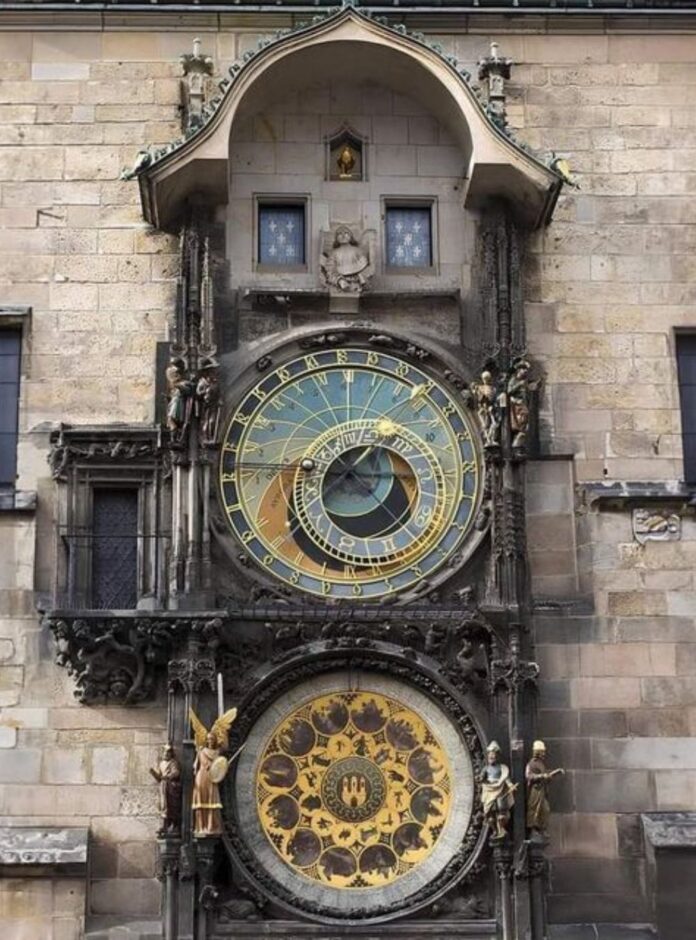

In the heart of Prague’s Old Town Square, where cobblestone streets hum with centuries of footsteps and whispers of empire, stands a masterpiece that has measured time for more than six hundred years — the Prague Astronomical Clock.
Mounted on the southern wall of the Old Town Hall, this medieval marvel was first installed in 1410, making it not only the oldest astronomical clock still in operation but also one of the most intricate and mysterious timepieces ever created. It is more than a clock — it is a living calendar, a cosmic diagram, and a mirror of human curiosity and ambition carved into brass and stone.
A Machine Beyond Time
At first glance, the clock seems like a window into the heavens themselves. Its upper dial, a complex astronomical instrument, tracks the movement of the Sun and Moon through the zodiac. It displays the current phase of the Moon, the position of celestial bodies, and even the time of sunrise and sunset. To medieval citizens of Prague, this was not just science — it was magic.
Every hour, crowds gather beneath the tower to witness a spectacle that has captivated travelers for centuries. As the bells chime, small wooden figures come to life — the Twelve Apostles march past tiny windows, a skeletal figure of Death rings a bell, and a proud rooster crows to signal the triumph of another passing hour. The performance lasts only a minute, yet it leaves a lasting impression, a reminder that even time can be turned into art.
A Testament to Genius and Mystery
The clock was the creation of Mikuláš of Kadaň, a master clockmaker, and Jan Šindel, a professor of mathematics and astronomy at Charles University. Together, they fused engineering, art, and astronomy into a single breathtaking design.
Legend, however, gives the story a darker twist. It is said that the clockmaker was blinded after completing his masterpiece, to ensure that he could never build another like it. In revenge, he supposedly threw himself into the gears, cursing the clock and bringing it to a halt. For generations afterward, Prague’s citizens believed that misfortune would strike the city if the clock ever stopped ticking.
Though myth and history intertwine, the clock’s survival is a miracle in itself. It endured fires, wars, and even Nazi bombings during World War II, which left much of Old Town in ruins. Yet the clock was painstakingly restored, piece by piece, by devoted craftsmen who refused to let time erase its rhythm.
The Symbol of a City That Endures
Today, the Orloj, as it is known in Czech, remains one of Prague’s greatest treasures — not because of its age, but because of what it represents. It is a symbol of endurance, creativity, and humanity’s eternal fascination with the cosmos.
Beneath its gilded face lies a philosophy older than science itself: that life, like the heavens, moves in cycles — of light and shadow, creation and decay, past and renewal. Every rotation of its gears tells a story of resilience, echoing through the centuries like the heartbeat of the city it guards.
Tourists may come for photographs, but those who pause long enough to listen can hear something deeper. Between the chimes and mechanical murmurs, the clock whispers the truth that has outlasted kings and empires — time belongs to no one, yet it unites us all.
A Legacy Still Alive
Standing beneath the Orloj today, watching its figures dance against the Gothic stone, one can’t help but feel awe for those who built it. In an age without modern tools, they achieved perfection that still functions six centuries later.
The Prague Astronomical Clock isn’t merely a machine; it is a soul carved into brass and wood, ticking faithfully through revolutions, invasions, and ages of change. It is proof that while time passes, beauty — when born of imagination and devotion — can remain eternal.
Source: Prague City Tourism Archives, Czech National Museum.
This article is written for historical and cultural appreciation and entertainment purposes.